
Definition of logistics automation
Published:
2023-03
Logistics automation is a system engineering that integrates optics, machinery, and electronics. It is a system that integrates logistics and information flow with computers and modern information technology. It involves multiple disciplines, including: laser navigation, infrared communication, computer simulation, image recognition, industrial robots, precision machining, information networking, and other high-tech. At present, logistics automation technology has been widely used in industries such as post and telecommunications, commerce, finance, food, warehousing, automobile manufacturing, aviation, and docks.
Logistics automation refers to the use of computer network control systems to interact with high-performance related equipment such as transportation tools, industrial robots, warehousing facilities, and communication links in time and space, forming an organic overall system with specific functions. The system consists of an unmanned guided vehicle, a high-speed stacker, an industrial robot, a conveying machinery system, and a computer simulation joint commissioning center monitoring system.
Computer simulation systems are designed to create an intuitive virtual reality environment for users, allowing them to experience the operation of the system as if they were in person. The laser guided unmanned vehicle uses the laser light emitted by the laser scanning hair to determine the position of the vehicle through the information fed back by the peripheral reflection strip. The route and function of the trolley are controlled by a computer. Not only has high positioning accuracy, but also it is particularly flexible to set and change paths.
High performance stereoscopic warehouses are managed uniformly by computer systems, using barcode automatic identification technology. The system can accurately and quickly locate and store goods from the stereoscopic warehouse using high-speed elevators based on different goods codes entered into the computer in advance. And can automatically complete different tasks based on specific factors such as the inbound and outbound time of goods.
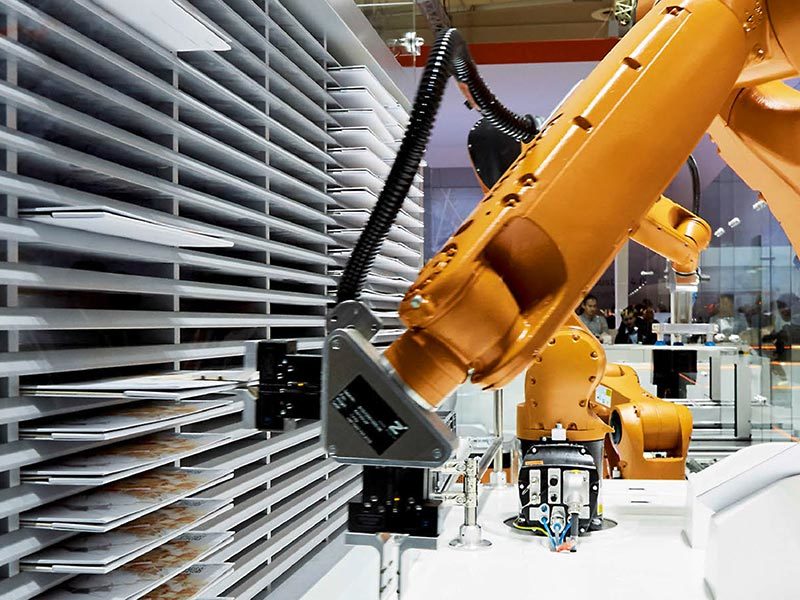
Industrial robots neatly stack the objects flowing to the terminals on the conveyor line to complete the entry and exit of goods, sorting, and other tasks. The entire process is smooth and automated.
Logistics automation has significant advantages in improving the level of warehouse management. Due to the adoption of computer control management, each controlled device automatically completes sequential operations. Shorten material turnover management, shorten work cycles, and correspondingly improve warehouse throughput to meet the needs of modern production. Secondly, it improves the degree of automation and warehouse efficiency, saves labor, and improves productivity. Third, the storage capacity is small, the floor area is small, materials are not stacked against each other, and access does not interfere with each other, ensuring the quality of inventory materials.
Related News

Copyright © 2023 Qidong Yidatong Automation Equipment Co.,Ltd.